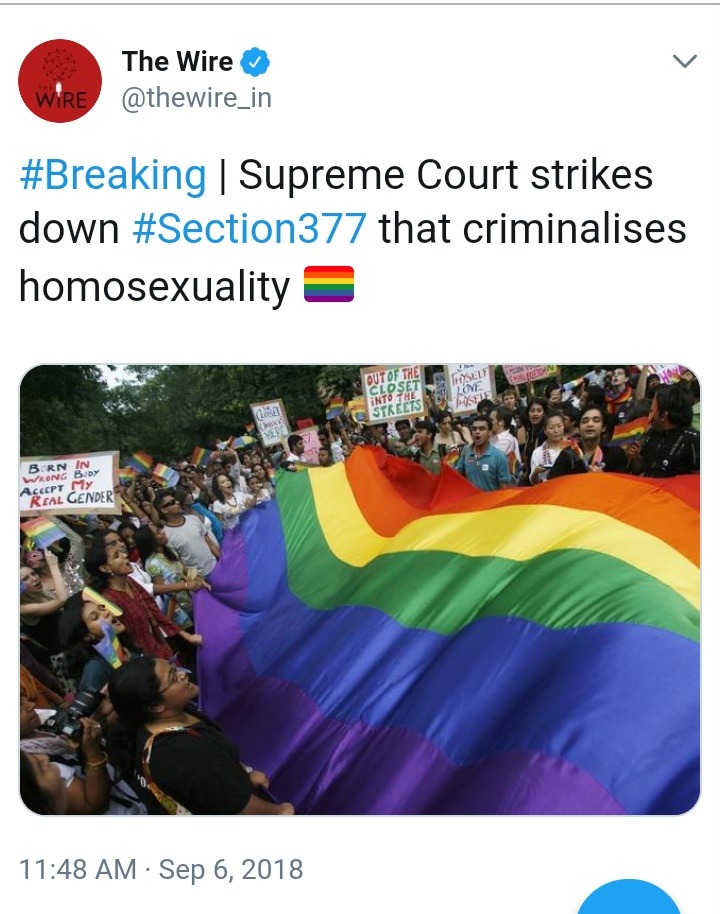
The second largest country in the world just decriminalized homosexuality. The Supreme Court of india struck away a colonial era ban on gay sex. “History owes an apology to LGBT persons for ostracisation and discrimination; It is difficult to right a wrong by history. But we can set the course for the future.” This is such a victory for the lgbtq+ community within India and all over the world. 🏳️🌈🏳️🌈🏳️🌈
The standard explanation offered by Africans opposed to gay rights is that homosexuality is alien to their culture and was introduced to Africa by European colonialists. A good deal of African-American homophobia relies on the same justification. But late 19th-century records on Africa and African oral history show that homosexual practices existed in pre-colonial Africa. One case in point are the Azande people in the north-east of modern-day Democratic Republic of the Congo (DRC), where it was acceptable for kings, princes and soldiers to take young male lovers.
Further evidence for the existence of homosexuality is that pre-colonial African ethnic groups ascribed tribal classifications to gay people. While some of these categorisations had negative associations, many had neutral connotations. Certain tribes in pre-colonial Burkina Faso and South Africa regarded lesbians as astrologers and traditional healers. A number of tribal groups in Cameroon and Gabon believed homosexuality had a medicinal effect. In pre-colonial Benin, homosexuality was viewed as a boyhood phase that males passed through and eventually grew out of.
“I HAVE NEVER AND WILL NEVER APOLOGISE FOR MY SEX LIFE! GAY SEX IS NATURAL, GAY SEX IS GOOD! NOT EVERYBODY DOES IT, BUT…HA HA!,” George Michael (June 25, 1963 – December 25, 2016), May 12, 2011. Repost from the incredible @17days. #lgbthistory #HavePrideInHistory
I saw someone post today that they didn’t even know trans lesbians were a thing except very recently, and I guess that’s a failure on the part of those from my generation and above who haven’t passed down enough history. So here’s some history for you.
There’s also Carol Riddell who was active in radical feminist organizing in Britain in the 1970′s
depression and anxiety and loneliness is a ‘gay person living in a straight culture’ thing not a gay culture thing…gay culture is community, gay culture is love and celebration, gay culture is creating a warm and accepting place within a hostile world, gay culture is mutual support, gay culture is strength and resilience, gay culture is feeling less alone in the world because you’ve found others like you.
cis people getting all their info on trans people from trans men hurts trans women tbqh
i hear so many people say “my trans male friend told me that [thing that practically does not apply to trans women] and therefore we need [thing that has horrible consequences for trans women]”
This is something which I see on Tumblr a lot. It’s really important to remember that there are issues that trans women face that have zero to do with trans men, so it needs to be only trans women weighing in on those things. I frequently see trans men for example weighing in on the problems with modern mainstream drag (RPDR et al.) and declaring them “not really problems because it doesn’t bother me personally”. That sort of thing needs to stop yesterday.
As a person who is uneducated on the issue… What is the problem with mainstream drag?
Whew…uh. Alright, short version.
So back in the day there was ball culture. Ball culture was the precursor to modern drag. Without ball culture, there is no drag. That’s the first thing you need to know.
So back in those days, “trans” wasn’t a word we really had yet in American english. “Transgender” hadn’t really been coined yet, even “transsexual” with all its problematic connotations barely existed outside of extremely clinical environments. But if you go back and read things actually written and said by the people who were in that early scene, they were primarily what we’d call “trans” today. And primarily people of color. For most of US history after colonialism happened, being trans and/or GNC has been dangerous, and for people of color extremely dangerous. Ball culture was a place for people of color with non-birth-assigned or variant gender expression to be themselves in a way that was both celebrated, and safe.
Things have changed, though, and not for the better. Over time, its become less celebration, and more spectacle. Less safe space, and more stage performance. There was always a stage, a show about it, but the ball culture was again about CELEBRATING the gender variant and non-conforming. Modern drag has become a parody, a point-and-gawk, the audience is primarily cis and white, and often even straight.
Rather than people who are often not allowed to be themselves to be more themselves, modern drag has become about people becoming someone they’re not, stage personnas that are taken up for a show and then set aside after, by people who will then turn and mock and show bigotry towards the very people who were once a part of and represented by it. This has become deeply ingrained in modern drag, to the point that if a drag performer comes out as trans, scenes frequently turn on them. They’re told that they’re “taking it too far”, rather than revealing more of who they are. They’re often looked down on and even outright shunned from drag scenes if they dare come out as trans.
RuPaul and his TV show have only aided this selling out of the culture that was to the masses at the cost of who drag once existed to serve. Games that invite contestants to guess if someone is “female or (anti-trans slur)” are a prime example of this. It’s a little less funny when you realize bigots play that game all the time, only when they spot a trans woman they beat or even kill us. And RuPaul isn’t dumb. He’s been around long enough to know exactly what he’s doing, but he’s too busy making his TV show money to care. When people in the trans community have tried to reach out to him, he’s talked down to us, told us that we’re too young to know better. I’ve been around long enough and studied my history enough to know that HE SHOULD KNOW BETTER. He uses anti-trans slurs in a show with a primarily cis and surprisingly straight-heavy demographic. He uses his fame to continue to defame trans women, and rather than listen, he demeans further. His show has recently even banned trans women completely. Like reflect on how far that is, how much of a theft of culture that represents.
The progenitor of drag was about celebrating trans and gnc people. Modern, mainstream drag is a sell-out making money on the backs of my sisters. That’s the problem.



 nev seisans' blog